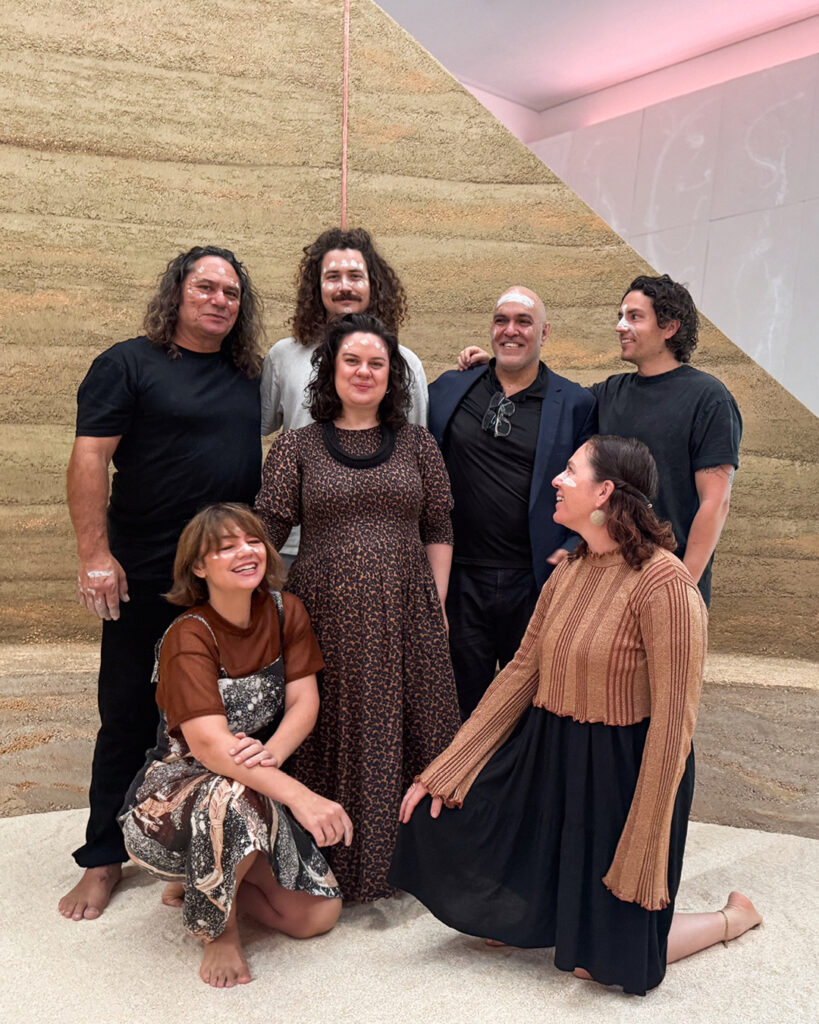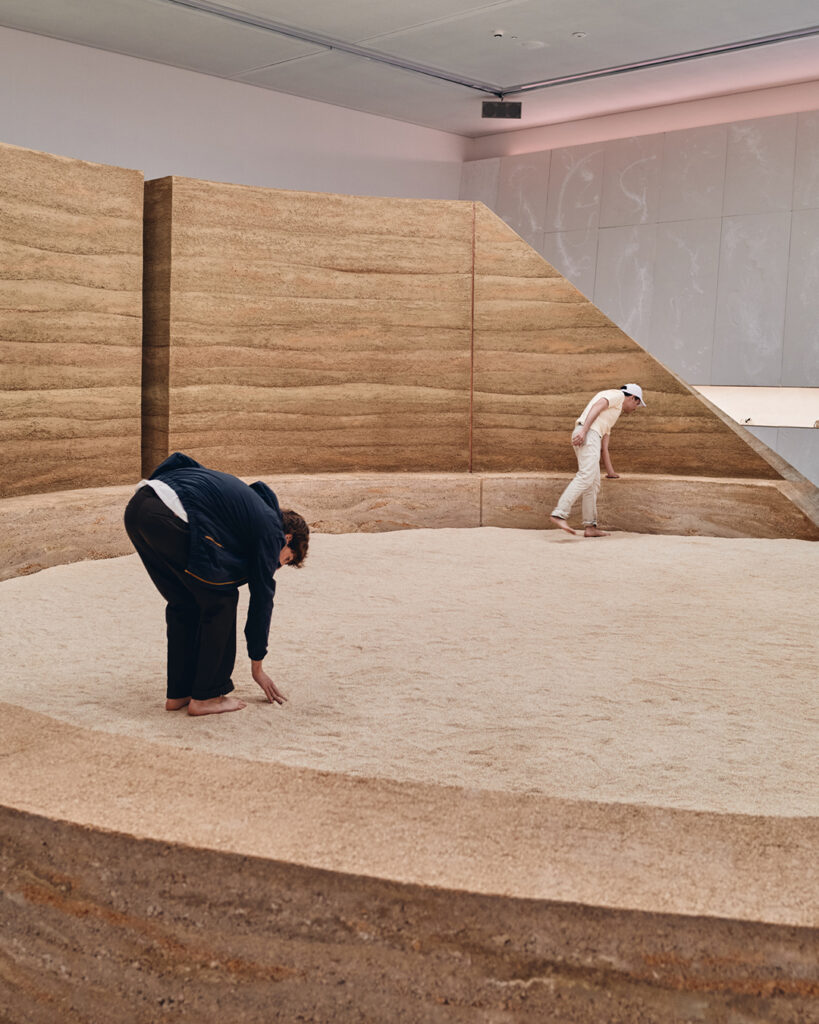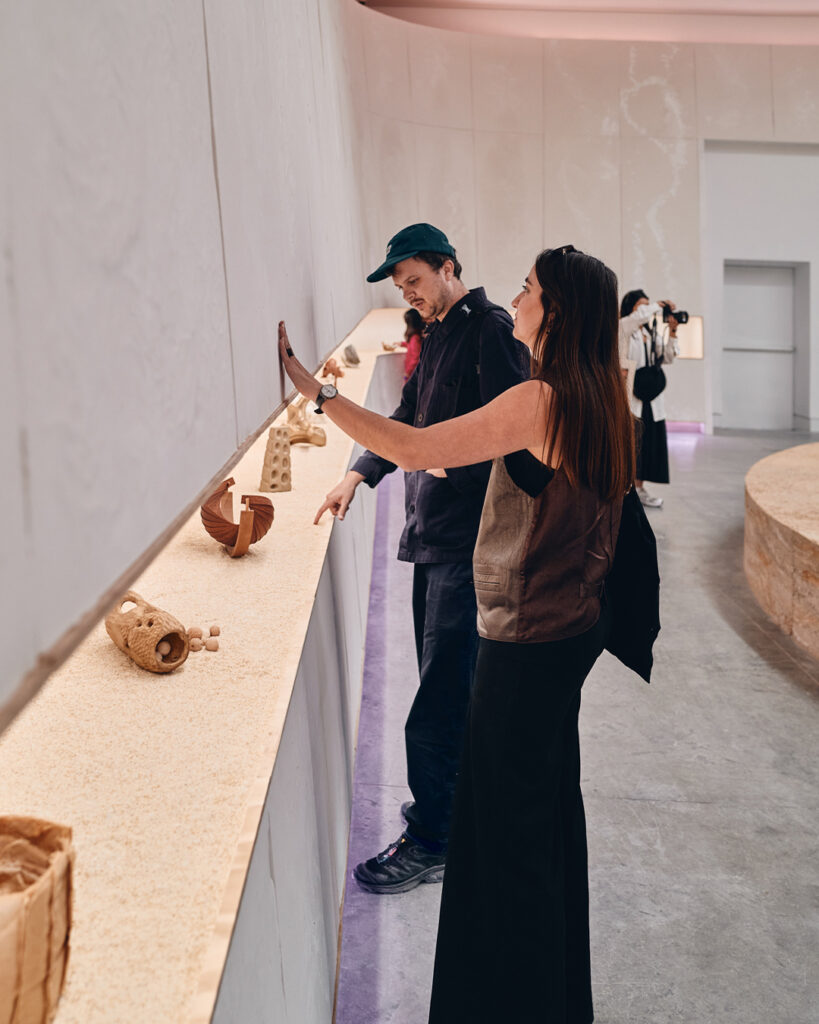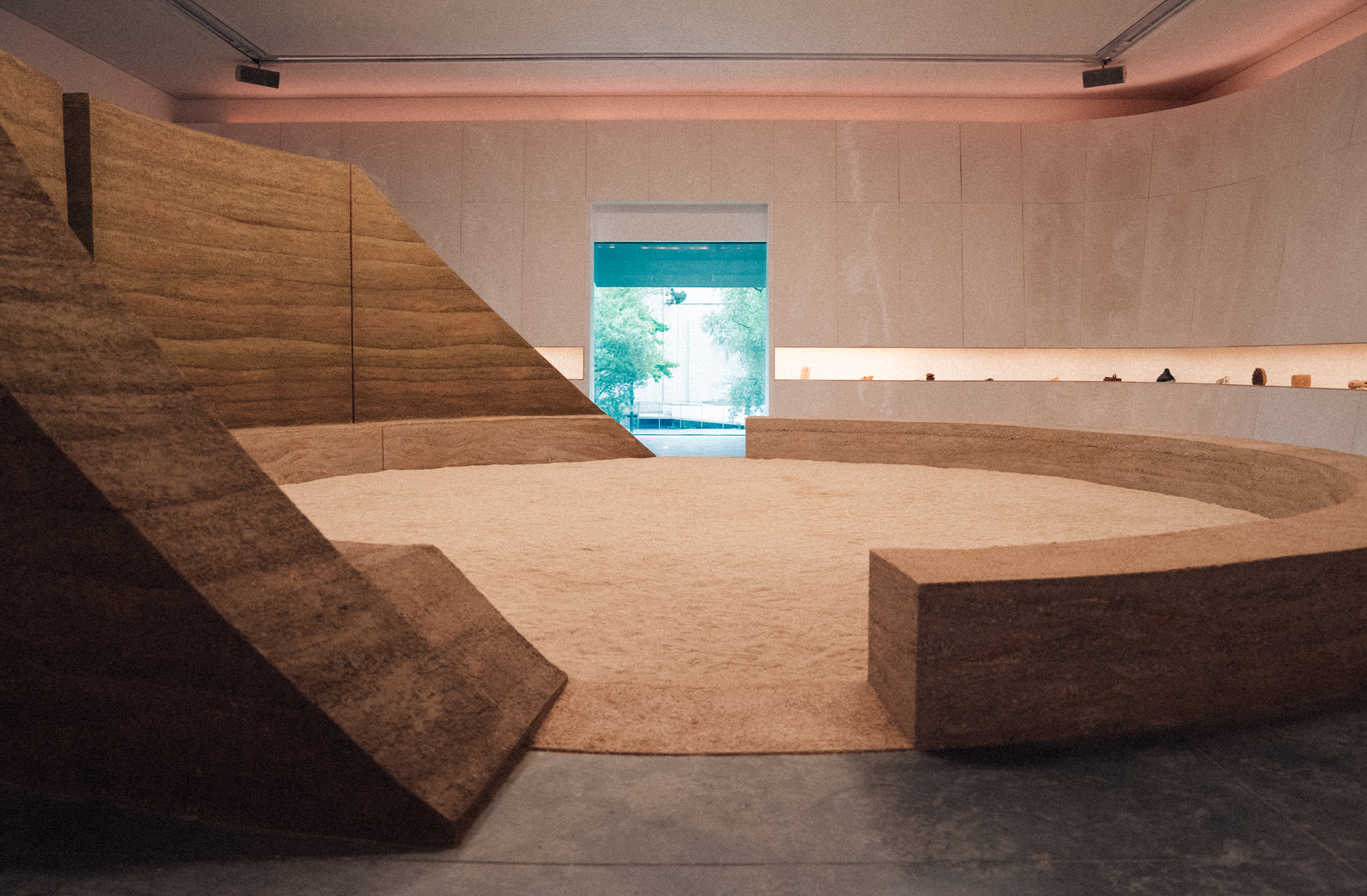
HOME as Country is a spectacular earth and plaster experience of place. Presented by the three appointed Creative Directors of the Australia Pavilion at La Biennale di Venezia 2025, in collaboration with a broader group of First Nations practitioners, the exhibition highlights the power of collaborative design. It encourages audiences to consider their connection to home and homelands, and to consider how we might care for every place we inhabit, design, and move through as if it were our own.
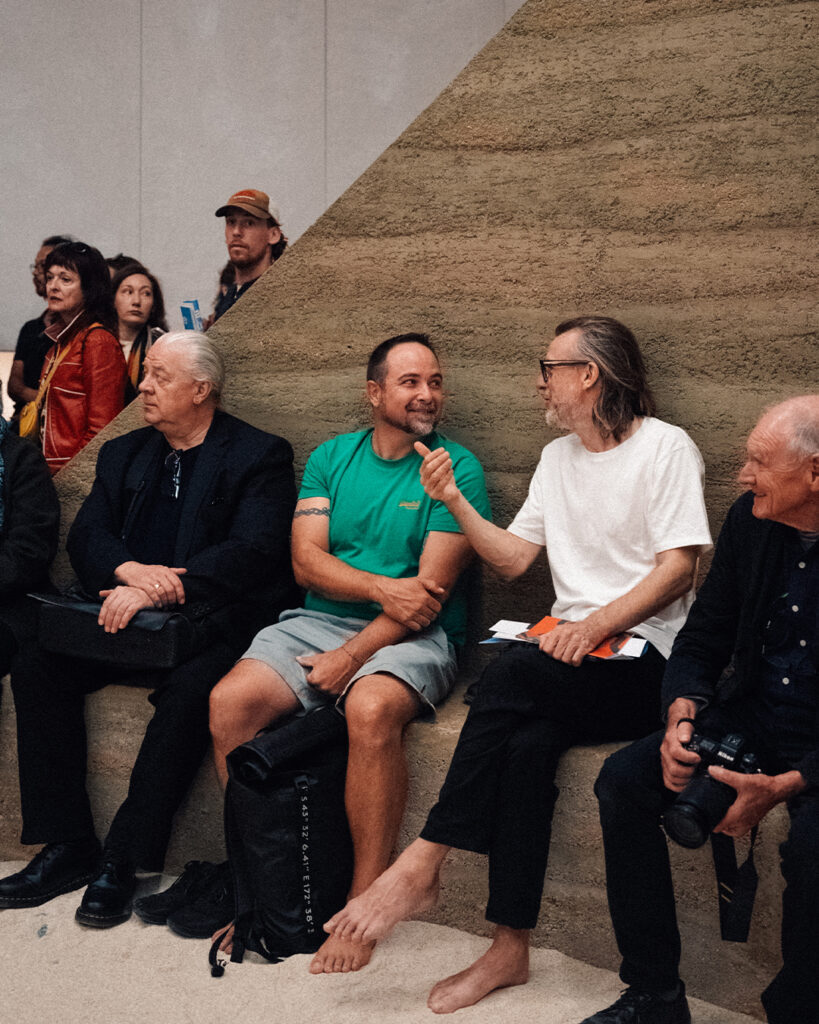
Visitors to the pavilion walk across the sand, leaving their footprints, to reach a gently curved seat wall. We were honoured to provide our Clayworks rammed earth finish, chosen in custom colours to reflect local soil.
HOME has brought together 125 architecture and design students from eleven universities in the largest School of Architecture collaboration in Australia, expanding understandings of First Nations cultural practices through memory, identity and materiality.
Clayworks founder Adam Weismann recently spoke to Creative Director Jack Gillmer-Lilley (Worimi & Biripi Guri), an associate and First Nations lead at multi-disciplinary practice SJB, and member of the Creative Sphere Bradley Kerr (Quandamooka), an architect and Associate Lecturer at the University of Sydney and Monash University. Together, they shared insights about the project, the significance of working with natural materials, and how HOME offers a powerful model for bringing First Nations cultural knowledge into conversation with contemporary architectural practice.
How has HOME been received at the Biennale?
Bradley Kerr: “We feel that HOME has been received with real warmth and respect. People have been taking their shoes off, walking on the sand, running their hands along the walls, and sitting to take it in slowly. It’s been called a standout at Venice because it invites people to bring their own stories, rather than being an overly didactic architectural response. It’s opened conversations about what others bring – the stories, processes and positions – and about how we gather, share our stories and experiences. Seeking out ways of celebrating intangible cultural relationships is an aspiration of many projects – we feel that we’ve taken a step in this direction”.
Tell us about the form – why were the curved walls and bench seat chosen to represent the ideas behind the project? What is the significance of the sand circle?
Jack Gillmer-Lilley: “In conceptualising the built form’s relationship with the notion of participant storytelling, yarning, human connection, breaking of hierarchies, comfort in humility, and transparency to name a few, we asked ourselves, how are people naturally going to gather in the institutional square box and plan that is the Australia Pavilion. As beings we gather in circular forms, think about how we gather around a campfire to tell stories, how we huddle during sport breaks, there’s equity in distance to the centre of the circle to have equal presence. The circular earth form holds people in relation to one another, it protects, grounds, and makes people present.
The circular form guides people to circulate around the exhibition calmly, encouraging tactile intuition to rest hands on the earth, and plaster of paris walls, to sit and choose to face inwards towards others, or outwards to engage with the patterns and forms on the plaster of paris walls that surround the space and hold the stories of the students ‘Living Belongings’.
The sand circle holds ceremony; ceremony of the memory of all who have visited HOME.
People leave their trace in the sand, through footprint, drawings, the tears and water ceremony of the opening, or the crawl tracks of babies and toddlers. Sand is everywhere, it’s something every being, human and non-human can relate to. Sand holds story of place and universe, it holds memory of every trace. Sand is landscapes eroded over eternity, telling stories of great floods as it settles back deep in the earth’s layers. Through water, currents and shifting ground, the grains traverse the earth, like beings, connecting us.”
How does the process of working with earth and clay materials help bring First Nations cultural knowledge into dialogue with contemporary architectural practice?
BK: “Working with earth and clay is not just a material decision, it’s important to consider these elements as living things existing through deep time. These materials carry cultural protocols as they require care, attention, and a respect for process as much as outcome. That way of working, which is deliberate, slower, intentional and responsive, brings First Nations ways of thinking into focus.
At HOME, earth materials were more than construction elements. The act of casting plaster and working with clay became a way of bringing people together. It created space for conversation, for learning through doing, for teaching and for sharing. The work is not passive, and it wasn’t led by a single author, it was shared. That’s central to how many First Nations communities pass on knowledge: through participation, repetition, and collective responsibility.
Architecture can often focus on permanence, precision, and finish but clay cracks, plaster holds marks of the oils of human interaction, sand shifts underfoot. These qualities, often perceived as defects or flaws, are reminders that buildings are part of living systems that change over time. They respond to weather, to people, to place. In this way, the materials are aligned with Country, not abstracted from it. Bringing these materials into contemporary practice challenges the usual boundaries of the profession. It means working with protocols that come from Country, not just from regulatory controls or cost. It requires collaboration and intentionality. In this way, it makes room for ways of designing that are relational.
There’s no one right way to do this. But when architects take the time to work with materials like earth and clay it opens up space for a deeper kind of practice. One that’s grounded, responsive, and accountable to the history of each place the materials are extracted from and then applied. “
What lessons from the HOME project do you think can be adopted in day-to-day architectural practice?
JGL: “One of the driving concepts behind HOME is how we connect again as people in all disciplines, not just architectural practice. How do we offer agency, strength, and custodianship to all people involved in projects.
We spend the most time with our colleagues, yet there’s a relentless barrier of expectations relative to hierarchical roles, behaviours, built on the notion of professionalism to fit within an existing system rather than connecting on a human and personal level. It’s about relationality, with each other, nature, cultures, discovering more about one another, breaking down these barriers to connect as people and share our stories. Through this process, in all professions, we believe it opens the door to true meaningful collaboration and agency for all. Shared values, principles, and diverse ideas and worldviews can drive innovative thinking for better and more sustainable futures.”
Beyond the Biennale, what’s next for the project?
JGL: “HOME will live on in those who participated in its development, making, story, and the exhibition. We hope what’s next is that the message and intentions of HOME will continue living through informing various disciplines and approaches to their practices.
The students who were engaged in the intensive elective to create ‘Living Belongings’ will carry lessons of Designing & Connecting with ‘Country’, and First Nations Peoples ways of practicing and understandings of the interconnected tangible & intangible world we live with, into their ongoing approaches to architecture.
As a ‘Creative Sphere’ of First Nations practitioners from various disciplines such as architecture, landscape architecture, urban design, planning, education, art, and curatorial to name a few, we are beginning to conceptualise how we each will continue the evolution of HOME relative to our practices. How will HOME pivot and develop into an innovative expression within these disciplines? The re-exhibition of HOME itself is in discussions with various institutions in Australia, keep an eye out for announcements on our Instagram page and website.”
HOME as Country at Venice Biennale runs until 23rd November 2025. For more information visit https://www.homeascountry.com.au/
Thank you to the HOME as Country project team, including Creative Directors Dr Michael Mossman, Prof. Emily McDaniel and Jack Gillmer-Lilley, Creative Sphere members Elle Davidson, Bradley Kerr, Kaylie Salvatori and Clarence Slocklee. Thanks also to approved Clayworks applicator Guy Valentine.
Instagram links: